Reducing Excess IGG Fuel Consumption by Over 58% During Cargo Discharge Operations

Rising fuel costs and increasing emissions exposure warrants greater scrutiny on auxiliary equipment performance during cargo operations. During analysis of discharge operations onboard a Medium Range (MR) Oil/Product tanker, GeoServe identified a significant variance between expected and reported Inert Gas Generator (IGG) fuel consumption.

GeoServe’s performance team compared the reported IGG consumption against expected consumption basis the operational demand and technical specification of the IGG,, identifying a substantial deviation during the discharge operation. The analysis considered discharge duration, expected inert gas demand basis the discharge rate, stoppages, and equipment performance benchmarks derived from the vessel’s technical specifications.

Observation:

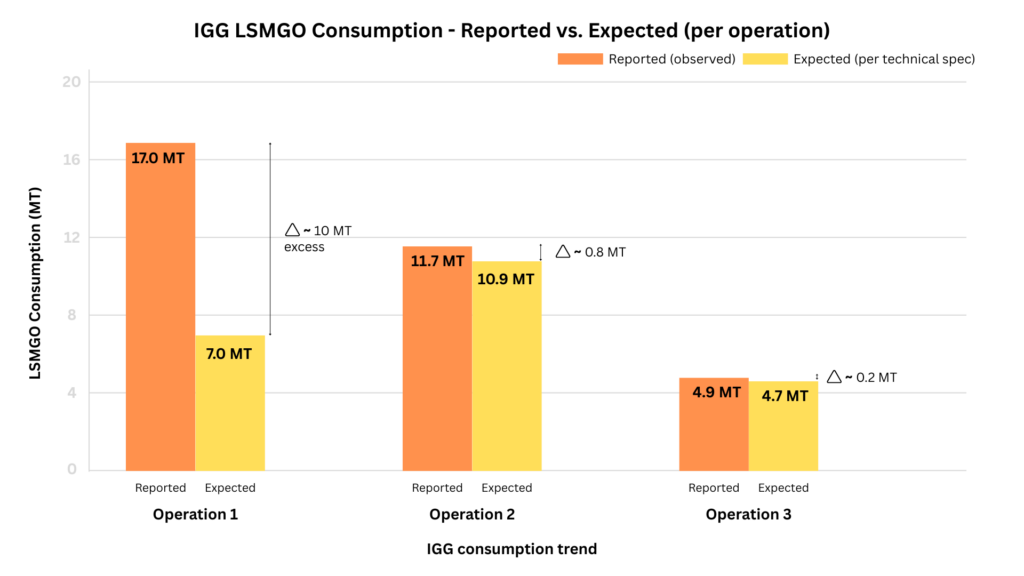
Basis the technical & operational data from the vessel, an excess consumption of 10 MT on the IGG was noted in a discharging operation of about 57 hours. The vessel had reported a consumption of 17 MT whereas the expected consumption was about 7 MT.

The observed consumption represented more than double the expected IGG fuel demand for the discharge profile under review.

Root Cause & Recommendation:

A list of queries and checks were sent to the vessel. Review with the vessel team confirmed that the atmospheric valve remained partially open during discharge operations, resulting in inert gas loss and sustained high-load IGG operation beyond actual demand requirements.

GeoServe recommended maintaining the IGG in automatic load-control mode during discharge operations where operating conditions permitted, reducing unnecessary venting and stabilising fuel consumption against actual inert gas demand.

Outcome:

Post-implementation monitoring of subsequent discharges has shown IGG fuel consumption trending in line with expected values, with the plant confirmed to be running in fully automatic mode without leaks. Subsequent discharge operations were benchmarked against the same operational baseline to verify performance stability and confirm reduction in excess fuel consumption.

In many cases, deviations of this nature remain difficult to identify through isolated consumption reviews because excess fuel usage can appear operationally justifiable within a single voyage. Trend analysis across repeated discharge operations is often where the variance becomes visible.

Estimated Annual Impact (considering 1 discharge operation/month):

  • ~120 MT LSMGO saved per year
  • ~USD 156,000 in fuel cost saved (LSMGO @ USD 1,300/MT)
  • Applicable if discharging operations in the EU:
    • ~390.61 MT CO₂ emissions avoided
    • ~EUR 29,034 (~USD 33,781) in EU ETS allowance (EUA) cost exposure avoided
    • ~EUR 4,727 in FuelEU Maritime exposure (7.33 MT CO₂-eq compliance balance) avoided

Key Takeaways:

  • Small deviations or human oversight in auxiliary equipment operations can increase fuel consumption and emissions exposure over time.
  • Continuous performance monitoring against technical performance baselines improves visibility into operational inefficiencies that may not be apparent within isolated voyage reporting.
  • Close coordination between vessel team and shore-based performance team is central to translating data insights into measurable outcomes.
  • Targeted, low-cost operational adjustments can deliver meaningful, fleet-scale reductions in fuel consumption, emissions, and operating costs.

As fuel costs, EU ETS exposure, and FuelEU compliance obligations continue to influence voyage economics, operational deviations during routine cargo handling are receiving greater commercial attention. Cases like this demonstrate how continuous vessel performance analysis can convert small operational corrections into measurable annual savings across fuel consumption, emissions, and regulatory exposure.

It is also a learning that for consistent improvement in operational efficacy, a close ship-shore collaboration and adaptation to best practices can significantly bring positive change while also contributing towards sustainability.

We’d like to hear from you!

Contact us today and one of our experienced team
members will connect with you soon.

Stay Connected

Subscribe to our newsletter to get company updates on your mailbox.