Navigating Ship Sales in the Green Era: Demystifying the 2025 BIMCO MoA Clauses
Ship sale and purchase (S&P) have always involved a high degree of contractual and operational complexity. With carbon regulations tightening across the maritime sector, S&P transactions now also involve the allocation of emissions-related liabilities and environmental compliance balances.
Key questions now arise: Who actually pays for pre-delivery emissions? And what happens if you inadvertently inherit a ship with a negative compliance balance?
To give the industry some much-needed legal breathing room, BIMCO has officially released its 2025 standard clauses for Memoranda of Agreement (MoA), specifically tackling the European Union Emissions Trading System (EU ETS) and the FuelEU Maritime regulation. These new clauses are designed to take the guesswork out of allocating carbon liabilities and environmental assets during S&P transactions.
Here is a look at how these new clauses change the game on the ground, and what you need to keep an eye on.
1. The EU ETS clause: clear-cut accountability
The EU ETS clause provides clarity by adopting a straightforward “polluter pays” approach. It draws a hard line in the sand at the exact time of the vessel’s delivery.
- Seller’s Responsibility: Sellers are strictly on the hook for all emission allowances for the Reporting Period up to the moment of delivery. They are required to submit a Verified Partial Emission Report and surrender those allowances.
- Buyer Protection: Nobody wants to pay for someone else’s footprint. The clause includes a robust indemnity provision, meaning sellers must hold buyers harmless against any claims, fines, or losses stemming from pre-delivery non-compliance.
- Buyer’s Handover: Once the keys (so to speak) change hands, the buyer instantly assumes full responsibility for surrendering allowances for all post-delivery emissions.
The Operational Reality:
On paper, this is beautifully simple. In practice, navigating this handover requires flawless data management. Making sure Verified Partial Emission Reports are accurate and submitted on time is no small feat. This transition places significant emphasis on accurate emissions monitoring, timely verification, and alignment with regulatory databases. Any discrepancies in reporting can create financial exposure for either party during the ownership transfer.
2. The FuelEU maritime clause: balancing the books
FuelEU Maritime introduces a fundamentally different compliance structure altogether. Unlike EU ETS, it introduces a flexible accounting system, allowing for the banking, borrowing, and pooling of a vessel’s GHG intensity “Compliance Balance.” This clause is inherently more complex, effectively turning a vessel’s environmental performance into a core financial asset (or liability).
- Strict Reporting Deadlines: Sellers can’t hide the ball. They must provide the vessel’s validated Compliance Balance for the two previous reporting periods, plus estimates for the current period, well before the delivery date.
- Financial Adjustments: If the ship has an estimated negative balance, buyers have the right to deduct a pre-agreed amount per tonne of CO2 equivalent right off the purchase price to cover the looming FuelEU Penalty. On the flip side, if a seller hands over a highly efficient ship with a positive balance, they can negotiate a well-deserved financial premium.
- Transfer of Rights: Upon delivery, the buyer takes the wheel on FuelEU compliance, inheriting all strategic decisions regarding the banking, borrowing, or pooling of that Compliance Balance.
The Operational Reality:
Calculating a vessel’s projected Compliance Balance isn’t just a quick math problem; it requires a deep understanding of complex GHG intensity metrics and alternative fuel impacts. Leveraging robust analytics and market intelligence – something we are incredibly passionate about at GeoServe, gives buyers and sellers the validated data they need to negotiate fair deductions or premiums without second-guessing.
Case Study: Illustrative exposure at change of ownership
To move from theory to practice, let’s look at how this actually plays out mid-year.
- The Scenario: Imagine Vessel A undergoes a change of ownership on 1 July 2026.
- The Assumptions: The EUA price is sitting at €90, the VLSFO emission factor is 3.114 tCO2/MT, and the FuelEU 2026 target is -2% versus the baseline.
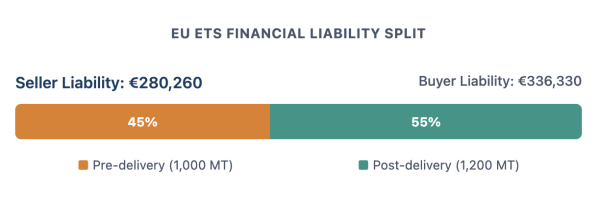
- The Fuel Consumption: Pre-delivery, the Seller Vessel consumes1,000 MT of VLSFO. Post-delivery, the Buyer vessel consumes 1,200 MT, totaling 2,200 MT for the year.
1. EU ETS exposure
- Seller (Pre-delivery): 1,000 MT burned ➔ ~€280k EUA Cost
- Buyer (Post-delivery): 1,200 MT burned ➔ ~€336k EUA Cost
The BIMCO Impact: Thanks to the ETS MoA Clause, the seller is responsible for surrendering allowances covering pre-delivery emissions (~€280k). The buyer is responsible only for their post-delivery emissions (~€336k), ensuring a clean financial separation and drastically reducing the risk of a dispute down the line.
2. FuelEU maritime exposure
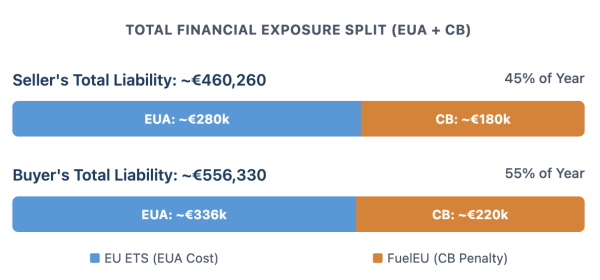
- Seller’s Share (~45%): 1,000 MT burned ➔ ~€180k Penalty Exposure
Buyer’s Share (~55%): 1,200 MT burned ➔ ~€220k Penalty Exposure
The Regulatory Reality: Here is the catch! The year-end responsible entity (the Buyer) is liable for the full penalty. The compliance deficit follows the vessel itself, not the ownership period. Getting the seller to reimburse their share depends entirely on how well your contractual settlement provisions are drafted.
Liability summary at a glance
| Regulation | Liability Allocation | Commercial Risk at Delivery |
|---|---|---|
| EU ETS | Split by ownership period | Clear if MOA clause applied |
| FuelEU Maritime | Follows vessel (year-end owner liable) | Buyer inherits deficit unless settled |
The Big Takeaway: While EU ETS exposure can be cleanly ring-fenced using the BIMCO clause, FuelEU Maritime exposure demands explicit financial true-up provisions at delivery to stop unintended liabilities from transferring to the buyer. Carbon exposure is officially a core transactional and contractual risk in S&P transactions. Because the year-end responsible entity remains liable for the vessel’s full compliance balance, financial settlement mechanisms must be explicitly addressed in S&P contracts to prevent unintended liabilities transferring to the buyer.
At GeoServe, our emissions and voyage analytics teams work closely with commercial and technical stakeholders to ensure that emissions exposure and regulatory compliance data are clearly understood before and during vessel transactions.
Our analysis
The release of these BIMCO clauses marks a genuine mindset shift. They formally embed carbon liabilities and assets into the DNA of S&P transactions. Here is our take on what this means for you:
- Direct Valuation Impact: A ship’s environmental record is now its financial record. Accumulated FuelEU Compliance Balances will systematically drive the final purchase price up or down.
- Expanded Due Diligence: The days of just kicking the tires and checking the engine are over. Emissions audits, Verifier reports, and compliance histories are now absolute must-haves during S&P inspections.
- The Art of Negotiation: The clauses don’t fix the financial value of a CO₂ equivalent—they leave it open. This means you must negotiate these rates case-by-case based on real-time market conditions.
- Timeline Bottlenecks: Because everything relies heavily on third-party verified data, there is a real risk of vessel handover delays if reporting bottlenecks happen. Proactive, hands-on management of your emissions data flow is no longer optional; it is essential.
We’d like to hear from you!
Contact us today and one of our experienced team
members will connect with you soon.
Stay Connected
Subscribe to our newsletter to get company updates on your mailbox.